How Gift Card Promotions Drive Revenue for Shopify Stores
6 min read
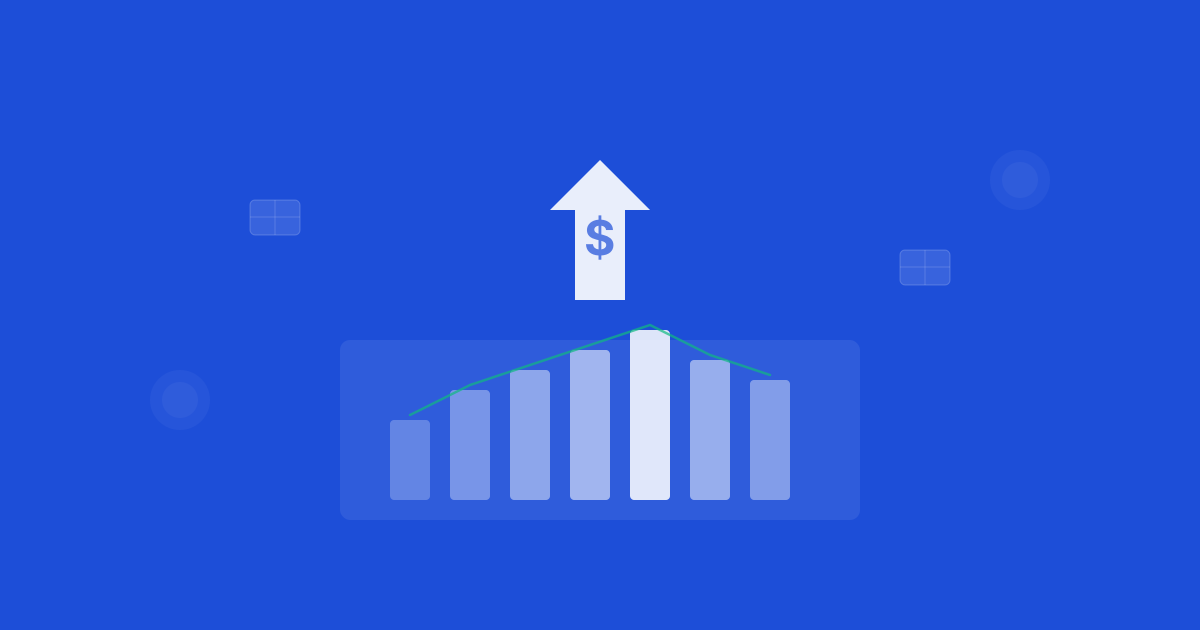
Gift card promotions drive revenue through four mechanisms: overspend (recipients spend more than the card value), breakage (unredeemed balances stay on your books), customer acquisition (gift recipients become new customers at zero ad cost), and reload behavior (loyal customers pre-commit spend by topping up their balance).
The economics work differently than discounts, and understanding these mechanics is what separates promotions that pay for themselves from ones that just move gift cards. Here's how each revenue driver works at every stage of the customer lifecycle.
Gift Cards Increase Average Order Value
When someone redeems a gift card, they rarely spend exactly the card's value. Most gift card holders spend more than the balance on their card.
Consider a $25 gift card redeemed against a $42 order. The customer pays $17 out of pocket. But from the store's perspective, the order total is $42, which is higher than the average order value for many Shopify stores.
This "overspend" effect is well-documented across retail. Gift card holders treat the balance as found money and spend more freely than they would with their own payment method.
How to Maximize the Effect
- Set card values below your average order value. A $25 gift card at a store with a $60 average order almost guarantees overspend. A $100 gift card at the same store might cover the entire purchase, reducing the uplift.
- Promote products just above the gift card value. Feature items priced at 1.5x to 2x the gift card amount. A $25 card holder browsing $35-50 items is a likely overspender.
- Make checkout frictionless. If paying the difference feels easy (clear balance display, simple payment split), customers are more comfortable spending above the card value.
Breakage Revenue Is Built Into the Model
"Breakage" is the percentage of gift card value that never gets redeemed. Not every gift card gets used. Some get lost, forgotten, or sit in an inbox indefinitely.
For promotional gift cards, expect 20-40% breakage. That breakage is money you committed (the gift card exists on your books as liability) but never actually flows out as product or service.
The Math
Distribute 100 x $10 promotional gift cards = $1,000 in total value.
If 65% are redeemed: $650 in gift card value is used, $350 in breakage revenue. Of the 65 redemptions, if the average overspend is $12: that's $780 in incremental revenue.
Total revenue impact: $650 (gift card value) + $780 (overspend) = $1,430 Effective cost: $1,000 - $350 (breakage) = $650 Revenue per dollar spent: $2.20
That's a 2.2x return on the promotional spend, before accounting for any customer lifetime value from new customers acquired.
The Ethics of Breakage
Breakage should be a byproduct, not a strategy. Design your promotions for redemption, not for forgetting. Reminder emails, clear expiration communication, and easy-to-find redemption instructions are all good practice. If your breakage rate is 60%+, your promotion isn't reaching the right people or the offer isn't compelling enough.
Customer Acquisition Through Gifting
When an existing customer buys a gift card for someone else, you acquire a new customer at zero acquisition cost. The existing customer paid for the gift card. The new customer visits your store to redeem it.
Why This Matters
Paid customer acquisition costs continue to rise across every platform. Facebook, Google, and TikTok ads all cost more per click and per conversion than they did a year ago. Gift cards offer a different path:
- Existing customer buys a $50 gift card (you receive $50 in revenue)
- Recipient visits your store (zero acquisition cost)
- Recipient browses, redeems, and spends above the card value
- Recipient becomes a customer you can market to going forward
The gift card buyer effectively financed the acquisition of a new customer, and you received full-price revenue in the process.
Promotional Amplification
Combine gifting with promotions to accelerate this:
- "Buy a $50 gift card, get a $10 bonus for yourself." The buyer is rewarded for introducing someone new to your store.
- Referral gift cards. Instead of a coupon code, give referrers a gift card to share. It feels more valuable and drives higher conversion.
- Holiday gifting pushes. Position your gift cards as the go-to gift during peak seasons. Every gift card sold is a potential new customer.
Loyalty Through Reload Behavior
Some customers treat gift cards as a way to budget their shopping. They load a set amount onto a gift card and spend from that balance. This behavior, called "reload," is common with brand-loyal customers.
Reload behavior is valuable because:
- Committed spend. Money loaded onto a gift card will be spent at your store. It's pre-committed revenue.
- Predictable cash flow. If customers reload monthly, you have a steady revenue stream.
- Lower acquisition costs. You're not paying to re-acquire these customers each time they shop.
To encourage reload behavior, make it easy: prominent "reload" or "add balance" options, suggested amounts, and maybe a small incentive ("Add $100, get $5 bonus balance").
Promotional Campaign Ideas That Drive Revenue
The Threshold Bonus
"Spend $75 or more and receive a $10 gift card."
This increases average order value (customers add items to hit the threshold) and creates a guaranteed return visit. The $10 gift card is your cost, but the incremental revenue from larger orders often covers it and then some.
The Seasonal BOGO
"Buy a $50 gift card, get a $10 bonus card free."
Run this during gifting seasons. You sell $50 in gift cards (cash in the bank) and give away $10 in bonus cards. The bonus cards drive a second visit, often with overspend.
The Win-Back Card
"It's been a while. Here's $10 on us."
Target customers who haven't purchased in 90+ days. The cost is $10 per reactivated customer. If even 30% redeem and the average order is $40, you've spent $10 to generate $40 in revenue from a customer you were losing anyway.
The VIP Surprise
Send unexpected gift cards to your top 5% of customers by lifetime value. No promotion, no requirement, just "Thanks for being a great customer."
The surprise factor creates social sharing, word-of-mouth, and deep brand loyalty. It's marketing that doesn't feel like marketing.
The Bundle Add-On
"Add a $25 gift card to any order for $20."
This works in checkout as an upsell. The customer gets $25 in value for $20. You get $20 in immediate revenue plus a future visit from whoever receives the card.
What Not to Do
Don't devalue your brand with constant promotions. If you're always running a gift card promotion, the promotion stops feeling special. Pick your moments and campaigns strategically.
Don't set expiration dates too short. Aggressive expiration (30 days) creates urgency but also frustration. Gift cards that expire before recipients can use them generate complaints, not revenue. Many jurisdictions restrict or prohibit expiration dates on gift cards entirely.
Don't ignore the data. Run every campaign with clear goals and tracking. If a promotion doesn't hit its revenue targets, adjust or retire it.
Don't distribute without targeting. Sending promotional gift cards to your entire list is expensive and inefficient. Segment by behavior (lapsed customers, high-value customers, first-time buyers) for maximum ROI.
Getting Started
Pick one campaign type that fits your current goals. If you need more revenue from existing customers, start with a threshold bonus. If you want to reactivate lapsed customers, try a win-back campaign. If holiday season is approaching, plan a BOGO promotion.
Create your promotional gift cards in bulk and track the results. Start small (50-100 cards), measure the impact, and scale what works. If your promotion volume makes pricing a concern, see how BatchCard compares to Rise.ai on cost and features. For step-by-step instructions, see our getting started guide.
For a broader view of gift card marketing approaches, see our complete marketing strategies guide. For automating delivery timing, check out our guide on scheduled gift card delivery. If you're focused on customer loyalty, our use case page covers retention-focused workflows.